Blockchain, Verified Credentials, and Personal AI: Building the Next Layer of Digital Infrastructure

The internet was originally built without built-in identity or security layers, forcing modern organizations to spend decades patching architectural vulnerabilities.

Today, the convergence of artificial intelligence, blockchain ledgers, and verified credentials is establishing a new foundation for systemic trust.

On the latest episode of AIScento, host John Okoro interviewed Dr. Michael Becker to examine how decentralized identifiers, digital wallets, and personal information management systems (PIMS) are reshaping business operations and data ownership.

3 Structural Innovations Transforming Digital Trust
1. W3C Verified Credentials & Digital Wallets
Global jurisdictions including the European Union, Bhutan, and US states like Utah are deploying cryptographic verified credentials that allow citizens to prove attributes (such as age or authorization) without exposing underlying personal data.

2. Blockchain as an Identity Verification Layer
Beyond cryptocurrency, blockchain ledgers provide tamper-proof, non-repudiable records that allow organizations and AI agents to verify identity claims with mathematical certainty.

3. Personal Information Management Systems (PIMS)
Moving away from centralized corporate data silos, PIMS models enable individuals to maintain encrypted “databases of me,” giving consumers control over how their data is accessed, monetized, or shared.

Balancing Operational Efficiency and Privacy Safeguards
While AI agents drastically reduce task processing time from days to minutes, leaders must carefully navigate critical implementation risks:

Informed Consent vs. Secondary Data Use: Businesses cross ethical and regulatory lines when collecting data beyond primary service needs or selling data without explicit consent.

Autonomous Agent Governance: AI agents executing tasks at high speed require strict cloud protections and sandboxing to prevent catastrophic database or operational failures.

Environmental & Societal Externalities: Organizations must account for the high energy, water, and computational costs associated with large-scale AI deployment.

Watch the Episode
Learn how to structure privacy-preserving AI and blockchain architectures for your organization:

📺 Watch the Full Video:


Join the Aiscento Community

1️⃣ Listen: Hear from other innovators cutting through the noise on the Aiscento Playlist.

2️⃣ Discover: See the platform we are engineering at the Aiscento Platform.

💼 Connect: Join our professional ecosystem on Aiscento LinkedIn.

📺 Subscribe: Follow our official channel on YouTube for full video podcast episodes and strategy breakdown sessions.

#VerifiedCredentials #DecentralizedIdentity #PIMS #DataGovernance #AIInfrastructure #BlockchainTrust #AIScento

Tagged with: , , , ,
Posted in Uncategorized

Who Owns Your AI Identity? Navigating Privacy, Digital Twins, and the Future of Trust

As organizations and consumers rapidly adopt artificial intelligence, a fundamental question emerges: who owns and controls the digital identity created by our online interactions?

Every prompt entered into a large language model, every website login, and every digital transaction builds a comprehensive representation of our personal and professional lives.

In a detailed discussion on the AIScento Podcast, host John Okoro sat down with Dr. Michael Becker—Founder and CEO of Identity Practice to unpack the intersection of AI, self-sovereign identity, and digital privacy.

They explored how leaders and individuals must transition from being passive consumers of digital tools to actively managing their personal and organizational data agency.

Key Takeaways for Business Leaders
Digital Identity Beyond Passwords: Digital identity is no longer just a username and password; it encompasses five domains of private data, including behavioral patterns, preferences, and predictive insights generated by third-party data brokers.

The Shift to Fidgetal Reality: Modern professionals are “fidgetal” beings operating simultaneously across physical and digital realms making digital identity management as vital as managing physical health and security.

The Rise of Digital Twins: Within the next three to five years, individuals will rely on personal AIs (digital twins) that act on their behalf to manage commerce, communication, and schedule execution.

Reversing Terms of Service (MyTerms): Emerging standards like IEEE’s MyTerms will allow individuals and their AI agents to assert personal access terms that businesses must legally accept before collecting data.

Actionable Steps to Protect Digital Sovereignty
Practice Distrust and Verify: Move away from legacy assumptions of online trust by verifying requests, avoiding unvetted links, and auditing data permissions.

Deploy Unique Credentials: Use a password manager combined with email aliasing so every vendor interaction relies on a unique username, email address, and password combination.

Secure Data Across Network Boundaries: Evaluate AI tools using Dr. Becker’s three boundaries relational (public vs. private), environmental (cloud vs. local device), and sovereign (cryptographic control).

Watch the Full Podcast Interview:


Join the Aiscento Community

1️⃣ Listen: Hear from other innovators cutting through the noise on the Aiscento Playlist

2️⃣ Discover: See the platform we are engineering at the Aiscento Platform.

💼 Connect: Join our professional ecosystem on Aiscento LinkedIn.

📺 Subscribe: Follow our official channel on YouTube for full video podcast episodes and strategy breakdown sessions.

#DigitalIdentity #AIPrivacy #Blockchain #SelfSovereignIdentity #Cybersecurity #TechLeadership #AIScento

Tagged with: , , , ,
Posted in Uncategorized

Why AI Won’t Save a Broken Business: Shifting from Superhero Leadership to Business Architect

In the rush to adopt artificial intelligence, many companies are making a costly mistake: throwing AI at broken operational processes and expecting magic.

Simply plugging an advanced language model into an inefficient workflow or a disconnected team will only automate confusion and accelerate operational failure.

In an in-depth interview on the AI Scento Podcast, John Okoro sat down with Sarah Marshall former executive at Google and Logitech and Founder/CEO of Operations Architect to discuss why AI adoption is fundamentally a leadership and operating model challenge, rather than a mere technology upgrade.

To succeed in an era of continuous disruption, organizations must restructure how decisions are made, how leaders delegate, and how infrastructure supports human execution.

Key Takeaways for Business Leaders
Disruption is the New “Tuesday”: Modern organizations face multiple major disruptions every year, ranging from technological shifts to market volatility.

Success requires embedding disruption management into daily operational practices as an incremental, standard process, rather than relying on heroic, one-off pivot efforts that burn out teams and waste capital.

Leader as Architect, Not Superhero: Historically, leaders acted as “superheroes” holding strategy and execution together through sheer force of will and individual expertise.

Today, leaders must act as systems architects who design light, adaptive governance infrastructure building transparency, clear ownership, and accountability into the organizational model.

White-Collar Work is Being Redefined: Unlike previous tech waves that primarily impacted blue-collar physical roles, large language models hit white-collar knowledge work directly.

Executives and operational leaders now need to become “builders” who design AI agents and automated agent swarms to support complex functional workflows.

Building an Adaptive Culture: Organizational agility relies on culture rather than toolsets.

When ChatGPT launched, Sarah’s team at Google completely pivoted their annual strategy in six weeks and deployed a large language model directly into their tech stack within 14 weeks a turnaround powered by an adaptive, low-friction organizational culture built on trust and experimentation.

Actionable Steps to Get AI-Ready
Identify the Business Problem First: Avoid adopting AI simply because of market trends.

Clearly define the specific operational bottleneck or customer problem you need to solve, evaluate all alternative solutions, and choose AI only when it proves to be the most effective option.

Account for Real Operational Costs: AI implementation carries substantial hidden costs.

Inference requests consume significantly more computational energy and financial resources than standard search requests, meaning naive deployment can easily replace one expense with a much higher one.

Bridge Technical & Functional Expertise: High-performing deployment requires pairing technical engineers with domain-matter experts.

Ensure your senior functional experts work side-by-side with AI specialists to establish guardrails, conduct quality checks, and prevent hallucinated outputs from reaching customers or clients.

Watch the Full Podcast Interview

Gain deep insights into bridging the gap between strategy and execution:


Join the Aiscento Community

1️⃣ Listen: Hear from other innovators cutting through the noise on the Aiscento Playlist.

2️⃣ Discover: See the platform we are engineering at the Aiscento Platform.

💼 Connect: Join our professional ecosystem on Aiscento LinkedIn.

📺 Subscribe: Follow our official channel on YouTube for full video podcast episodes and strategy breakdown sessions

#AILeadership #BusinessTransformation #OperationsStrategy #AIReady #FutureOfWork #LeadershipDevelopment #AIScento

Tagged with: , , , ,
Posted in Uncategorized

AI Ends Where Taste Begins: Guardrails for Marketers and Fractional Operators

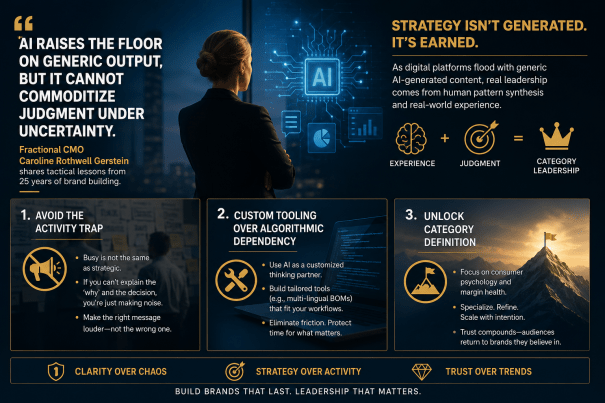
AI raises the floor on generic output, but it cannot commoditize judgment under uncertainty.” Fractional CMO Caroline Rothwell Gerstein shares tactical lessons from 25 years of brand building.

The modern corporate executive role is changing rapidly, forcing professional service firms and fractional operators to reconsider how they differentiate themselves.

We recently explored this evolution with strategic advisor Caroline Rothwell Gerstein, diving into client onboarding systems, building intellectual property under intense pressure, and deploying customized AI frameworks natively.

As digital platforms become flooded with generic strategic memos generated in seconds, true executive leadership relies heavily on human pattern synthesis and real-world experience.

Avoiding the Activity Trap
A surprisingly common mistake among growing enterprises is confusing frantic activity with long-term strategy.

Launching ad-hoc social campaigns, constant promotions, and rapid content streams can easily create an illusion of progress.

However, busy motions are not the same as effective market positioning.

If a leadership team cannot clearly articulate why a campaign is launching right now and exactly what decision it is supposed to drive, it is simply amplification without alignment.

A brilliant campaign built on shaky positioning only serves to make the wrong message louder and faster.

Custom Tooling vs. Algorithmic Dependency
Rather than relying on out-of-the-box software subscriptions that homogenize brand output, elite operators are leveraging AI as a hyper-customized thinking partner.

Caroline highlights tactical execution, such as using advanced language models like Claude to spin up highly tailored, multi-lingual bills of materials (BOMs).

This approach allows lean consulting teams to bridge communication gaps between cross-functional engineering, product design, and marketing workflows instantly.

The goal is to eliminate administrative friction and protect executive time for high-value decision-making.

Unlocking Category Definition
To move from a business that simply competes to one that completely defines its category, founders must embrace deliberate, constrained scaling.

Looking closely at modern market disruptors reveals that hyper-growth is rarely the healthiest target.

By studying consumer psychology, focusing heavily on margin health, and remaining fiercely dedicated to specialized product craft, independent brands can easily outmaneuver generic competitors.

Audiences will continually return to brands they trust, even when bombarded by cheap, algorithm-driven alternatives on social feeds.


Listen to the Full Interview

Connect with the Guest

To explore custom fractional executive services or study modern brand architecture methodologies, discover more at Caro Consulting: https://caro.consulting/

Ensure your professional network stays updated by following Caro Marketing on LinkedIn to trace their latest operational updates: https://www.linkedin.com/company/caro-marketing/

Tagged with: , , , , , , , , , ,
Posted in Agile, AI, Artificial Intelligence, Uncategorized

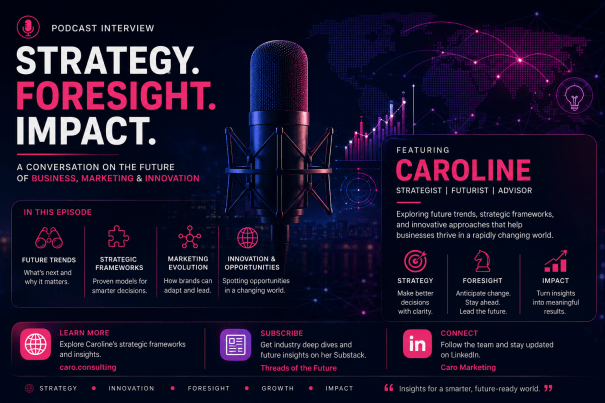
Beyond the Hype: How AI is Redefining Brand Architecture with Caroline Rothwell Gerstein

Is your business AI-native, AI-assisted, or building an agentic layer? Discover why true branding isn’t about output it’s about human judgment and trust at scale.

In a landscape dominated by rapid technological shifts, understanding the true intersection of brand identity and automation is crucial for long-term survival.

We sat down with Caroline Rothwell Gerstein founder of Caro Marketing / CRO Consulting, brand architect, and fractional CMO to unpack how artificial intelligence is fundamentally changing the way we scale businesses and engage audiences.

With over two decades of experience building early e-commerce infrastructure for disruptive brands, Caroline offers a refreshing, grounded perspective on the current AI wave.

Rather than viewing AI as a simple yes-or-no question, she breaks down the three distinct paths a company can take: becoming AI-native, AI-assisted, or deploying an agentic layer.

The Judgment Paradox
A critical mistake many modern leaders make is attempting to automate the soul of their company.

While AI completely industrializes the mechanical side of marketing such as AB testing, complex segmentation, and content variation it leaves the second half of the equation entirely untouched.

Taste, deep discernment, and core character remain exclusively human traits.

True brand scaling relies on knowing which data patterns to trust and which signals to ignore when making high-stakes commercial decisions.

The Silent Killer of Growth
Many founders frequently mistake their internal origin story for their market story.

While the passion behind building a product matters internally, everyday consumers do not purchase historical narratives; they purchase concrete outcomes.

Shifting the marketing lens from “why we started” to “why this matters to the user” is the core driver behind category-defining companies.

This clarity allows emerging brands to build deeper, localized trust in a noisy, crowded marketplace.

The Future of Ambient Commerce
Looking ahead over the next five years, the traditional concept of launching a marketing campaign will begin to feel completely outdated.

As agentic workflows begin to dominate web traffic, AI will handle the constant, real-time work of matching messages to specific consumer moments.

Marketing will morph into an ambient layer, making clean data structures and authentic human craft the ultimate competitive advantages.

The winning companies will be those that use technology to express truth faster, rather than simply producing cheaper content variants.


Listen to the Full Interview

Connect with the Guest

To learn more about Caroline’s strategic frameworks, visit the official website at Caro Consulting: https://caro.consulting/

You can also subscribe to her industry deep dives via her Substack, Threads of the Future, and stay connected with the team by following Caro Marketing on LinkedIn: https://www.linkedin.com/company/caro-marketing/

Tagged with: , , , , , , , ,
Posted in AI, AIScento, Artificial Intelligence, Auspicious Agile, Uncategorized

The Rise of Agentic Commerce: Are AI Agents Your Next Biggest Customers?

As e-commerce continues to scale rapidly across North America and Europe, the way digital transactions occur is about to undergo a fundamental transformation.

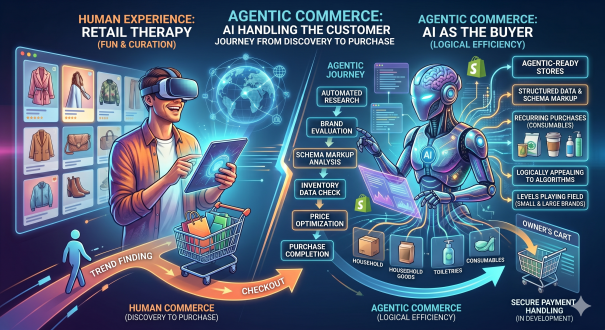
We are moving beyond traditional human-driven shopping into the realm of “Agentic Commerce” a future where AI agents don’t just recommend products, but actively handle the entire customer journey from discovery to purchase.

On a recent episode of the Aiscento Podcast, AI-powered performance marketing expert Kim Reynolds shared her insights on how agentic commerce will disrupt the digital marketplace and how brands can prepare.

What is Agentic Commerce?

In practical business terms, agentic commerce refers to an ecosystem where an AI agent researches products, evaluates brands, and eventually completes transactions on behalf of the consumer.

While humans will still engage in “retail therapy” for the fun of shopping, AI will increasingly handle recurring purchases and consumable goods.

Reynolds predicts that mainstream adoption of this technology could become a serious reality in as little as six months.

The primary missing piece holding it back right now is standardized secure payment handling for AI agents.

Preparing Your Store for AI Buyers

For small and mid-sized e-commerce brands, agentic commerce actually levels the playing field against massive enterprise competitors.

If you put in the legwork to make your store “agentic ready,” AI will recommend your products regardless of how big your marketing budget is.

How do you get ready?

It all comes down to structured data.

Platforms like Shopify are currently on the bleeding edge of this transition.

Simply toggling on their commerce features automatically builds out much of the necessary product schema.

The Takeaway

The future of e-commerce isn’t just about selling to humans; it’s about making your brand logically appealing to algorithms.

By focusing on detailed product descriptions, reliable inventory data, and robust schema markup, you ensure that when an AI agent goes shopping for its owner, your products are the ones going into the cart.


Join the Aiscento Community

1️⃣ Listen: Hear from other innovators cutting through the noise: Aiscento Playlist

2️⃣ Discover: See the platform we are engineering: Aiscento Platform

Join our professional ecosystem on LinkedIn: Aiscento LinkedIn

Watch the Full Video: Youtube

#FounderStories #TechStartups #AiscentoPodcast #VC #Scaleups #AIInnovation #AgenticCommerce #EcommerceGrowth #ArtificialIntelligence

Tagged with: , , , , , , , , , ,
Posted in Agile, Agile Teams, AI, AIScento, Artificial Intelligence, Auspicious Agile, Uncategorized

From Agile Compliance to Modern Adaptability

Over the last few years, a quiet exhaustion has settled over enterprise transformation communities. Many veteran consultants are actively dropping the word “Agile” from their professional vocabularies entirely.

The term has grown corporate, rigid, and tired.

Organizations became so completely obsessed with framework compliance checking boxes, tracking velocity metrics, and enforcing ceremonies that they entirely lost sight of the original goal: building a business that can pivot instantly in the face of disruption.

Now, as AI and quantum computing threaten to rewrite the corporate landscape, true adaptability is making a fierce comeback.

The Sovereign Value of Human Judgment

If a machine can compile a market report, parse a balance sheet, or build a functional app prototype in under ten minutes, where does a human leader provide a competitive advantage?

The answer lies entirely in contextual judgment and analytical skepticism.

AI operates strictly on historical data; it can predict patterns based on the past, but it cannot navigate unprecedented global events, understand human workplace dynamics, or apply creative reason to highly sensitive business constraints.

The AI Analytical Loop
1. System generates data-driven output.
2. Human applies contextual judgment.
3. Human challenges the model: “Explain your data and logic.”
4. Result: Verified, strategic action.

The most capable leaders in this new paradigm are those who treat AI as a volatile asset that requires rigorous audit loops. They don’t blindly accept what a model spits out; they demand to know the exact data and methodology used to reach that conclusion.

Managing the Volatility of Change
True agility in the machine age requires extreme fiscal and strategic discipline.

AI tools are not free; token costs stack up rapidly, and massive enterprise integrations can quickly bleed capital if left unmanaged.

As technology shifts at an exponential rate, long-term five-year strategic roadmaps are officially dead.

The companies that win won’t be the ones holding on tightly to rigid, decades-old process frameworks.

They will be the deeply adaptable organizations that protect their human core, ruthlessly manage their technology costs, and confidently rewrite their business models every six months.


Join the Aiscento Community
1️⃣ Listen: Hear from other innovators cutting through the noise: Aiscento Playlist

2️⃣ Discover: See the platform we are engineering: Aiscento Platform

Join our professional ecosystem on LinkedIn: Aiscento LinkedIn

Watch the Full Video: Youtube

#FounderStories #TechStartups #AiscentoPodcast #VC #Scaleups #AIInnovation

Tagged with: , , , , , , , , , , ,
Posted in Agile, AI, Artificial Intelligence, Uncategorized

The AI-Enhanced Executive: What to Delegate and What to Protect

As artificial intelligence moves from theoretical potential to practical application, executives face a critical strategic question: What should be handed over to algorithms, and what must remain firmly in human hands?

During his recent appearance on the Aiscento Podcast, strategic business advisor Cary Prejean broke down the realities of AI delegation for modern enterprises.

While AI is poised to become the ultimate virtual assistant for the C-Suite, leaders must understand its limitations to utilize it effectively.

What You Should Delegate Immediately

AI excels at rapid assimilation, data processing, and repeatable tasks.

Prejean recommends that organizations immediately start exploring AI integration for:

Financial Analysis: AI can ingest complex monthly financial statements and spit out detailed ratio analyses and industry comparisons in under five minutes a task that historically took human analysts hours.

Customer Service and Scheduling: Modern AI agents can cross-reference buyer history, answer nuanced questions with infinite patience, and seamlessly schedule appointments 24/7 without ever dropping the ball.

Inventory Management: AI is perfectly suited to monitor stock velocity, alerting leadership to slow-moving inventory that needs to be liquidated and recommending high-velocity items to restock.

The Boundary of Human Judgment

Despite these incredible capabilities, Prejean is adamant that AI will not replace the core functions of a CEO, CFO, or COO anytime soon.

Why?

Because AI lacks contextual human judgment.

AI can present a mathematical choice between Option A and Option B, but it cannot weigh the ethical implications, assess the impact on corporate culture, or navigate nuanced human relationships.

True leadership requires making value judgments that align with an organization’s deeper mission, something an algorithm simply cannot replicate.

How to Start in the Next 30 Days

If you are feeling overwhelmed by the rapid pace of AI, the worst thing you can do is freeze.

Prejean’s advice for the next 30 days is simple: don’t panic, but don’t hide.

Assign a trusted member of your leadership team to start researching how AI can solve your organization’s biggest, most specific bottleneck.

Dip your toe in, clean up your underlying data, and start experimenting.


Join the Aiscento Community

Discover: See the platform we are engineering: Aiscento Platform

Join our professional ecosystem on LinkedIn: Aiscento LinkedIn

Watch the Full Video: Youtube

#FounderStories #TechStartups #AiscentoPodcast #VC #Scaleups #AIInnovation #FutureOfWork #CSuite

Tagged with: , , , , , , , , , ,
Posted in Agile, agile business, AI, AIScento, Artificial Intelligence, Uncategorized

Stop Automating Chaos: Why Your AI Strategy Needs a “Well-Oiled” Foundation

In today’s hyper-competitive corporate landscape, leaders across North America and Europe are rushing to implement artificial intelligence.

The promise of massive productivity gains is incredibly alluring.

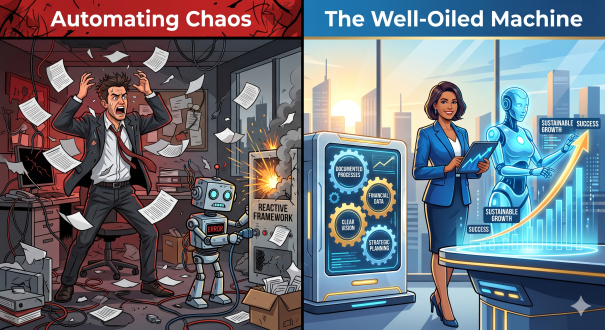
However, layering advanced AI tools over a broken, reactive operational framework is a recipe for disaster.

On a recent episode of the Aiscento Podcast, veteran CPA and strategic business advisor Cary Prejean warned against the dangers of “automating chaos” and outlined exactly how to build a foundation that is truly ready for AI integration.

The “Founder Bottleneck”

Before an organization can innovate, it must honestly assess its current state.

Prejean notes that most businesses eventually stall because the founder or CEO becomes the ultimate bottleneck.

When every decision must pass through one person, growth stops, and the company enters chronic “firefighting mode.”

You cannot successfully deploy AI if your organization relies entirely on heroic interventions from leadership rather than established systems.

The Three Pillars of a Well-Oiled Machine

To move away from bottlenecks and prepare for next-generation automation, leaders must establish what Prejean calls a “well-oiled machine.”

This requires three non-negotiable pillars:

Documented Processes: Every critical function must have a standardized, documented step-by-step process.

If employees are constantly guessing how to do their jobs, AI will have no clear parameters to operate within.

Actionable Financial Data: Managing by your “gut” or your checking account balance is obsolete.

Leaders need consistent Key Performance Indicators (KPIs) and regular financial ratio analyses to track liquidity, profitability, and efficiency.

Future-Focused Design: The CEO must declare a crystal-clear vision of what the company will look like in 5 to 10 years.

Clarity eliminates the distraction of chasing every shiny new technological object.

Making AI Work for You

Once your core processes are documented and your data is clean, AI becomes an incredible accelerator.

For example, instead of a manager spending hours drafting standard operating procedures (SOPs), they can feed rough employee notes into an AI agent to instantly generate comprehensive training manuals.

AI can also digest monthly financial statements in seconds, providing a detailed ratio analysis compared to industry standards.

But remember: AI is an amplifier.

If you feed it clean data and strong systems, you get a scalable enterprise.

If you feed it disorganization, you just get faster chaos.


Join the Aiscento Community

Discover: See the platform we are engineering: Aiscento Platform

Join our professional ecosystem on LinkedIn: Aiscento LinkedIn

Watch the Full Video: Youtube

#FounderStories #TechStartups #AiscentoPodcast #VC #Scaleups #AIInnovation #BusinessStrategy #ExecutiveLeadership

Tagged with: , , , , , , , , , ,
Posted in Agile, AI, AIScento, Artificial Intelligence, Uncategorized

The ROI of Somatic Intelligence: Unlocking Executive Clarity in the AI Era

When we discuss the future of corporate leadership, the conversation is heavily dominated by data analytics, automation strategies, and machine learning integration.

However, as AI handles more of the analytical and repetitive work, uniquely human capabilities like intuition, empathy, and nervous system regulation are becoming an organization’s ultimate competitive advantage.

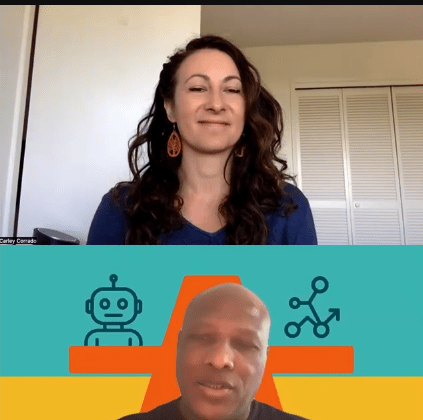
Dr. Carley Corrado, a former PhD scientist in chemistry and physics turned leadership transformer, joined the Aiscento Podcast to explain why concepts like “somatic intelligence” are no longer just wellness buzzwords.

They are foundational requirements for executive clarity.

The Problem with the “Floating Mind”

Many executives operate as “floating minds,” entirely disconnected from their physical bodies and operating strictly on cognitive overdrive.

This disconnect is dangerous.

According to Dr. Corrado, tension, unaddressed conflict, and the sheer volume of modern information overload live within the nervous system.

When an executive team lacks cohesion or carries unresolved interpersonal “ick,” it ripples down through the entire company.

It forms “eddy currents” whirlpools of wasted energy where projects stall, engagement drops, and top talent leaves.

Composting the Past to Build the Future

One of the most powerful tools Dr. Corrado introduces to analytical leaders is the concept of “composting.”

This involves doing the deeper work to recognize and release internal triggers and biases that dictate poor decision making.

Expand Your Range: By engaging in somatic practices (like intentional breathwork or taking deliberate space to process frustration), leaders can shift out of reactive, fear based responses.

Access Direct Intelligence: Quieting the “default mode network” (the brain’s inner critic) allows executives to tap into profound, unforced creativity.

Often, the solutions to complex organizational problems arrive not from staring at a spreadsheet, but from accessing an open, flow state mind.

Incorporate AI into Wellness: You can actually use AI to support your state of being.

Executives can prompt AI to help them structure daily workflows that protect their creative time, or even ask it for quick, three minute reset exercises between intense meetings.


Join the Aiscento Community

1️⃣ Listen: Hear from other innovators cutting through the noise: Aiscento Playlist

2️⃣ Discover: See the platform we are engineering: Aiscento Platform

Join our professional ecosystem on LinkedIn: Aiscento LinkedIn

Watch the Full Video: Youtube

#ExecutiveCoaching #LeadershipSkills #TechStartups #AiscentoPodcast #SomaticIntelligence #AIInnovation #BusinessGrowth

Tagged with: , , , , , , , , , ,
Posted in Agile, AI, AIScento, Artificial Intelligence, Auspicious Agile, Uncategorized
Categories