Enterprises everywhere are running dozens sometimes hundreds of artificial intelligence experiments. Yet, only a fraction ever survive the leap from impressive prototype to secure, mission-critical production.
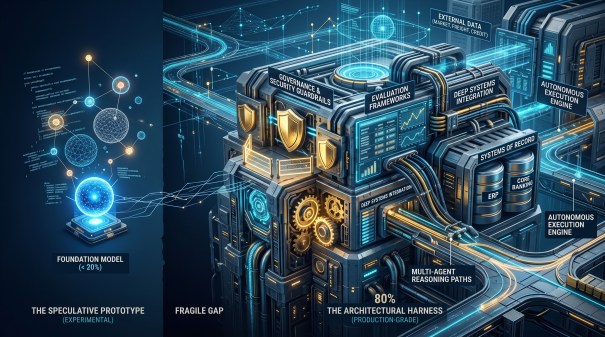
The bottleneck facing enterprise leaders is rarely the intelligence of underlying foundation models. Instead, it lies in the fragile gap between speculative demonstrations and production-grade reality: governance, evaluation frameworks, deep systems integration, and human-centered change management.
In an in-depth conversation on the AIScento Podcast, host John Okoro sat down with Raghav Aggarwal, Co-Founder & Managing Director of Fluid AI an enterprise AI platform based in Mumbai that has spent over a decade automating complex workflows across banking, energy, and the public sector.
Drawing on practical deployments ranging from global manufacturing optimization to high-speed commercial loan origination, Raghav broke down why foundation models are becoming commoditized and where the actual return on investment resides.
Key Takeaways for Enterprise Leaders
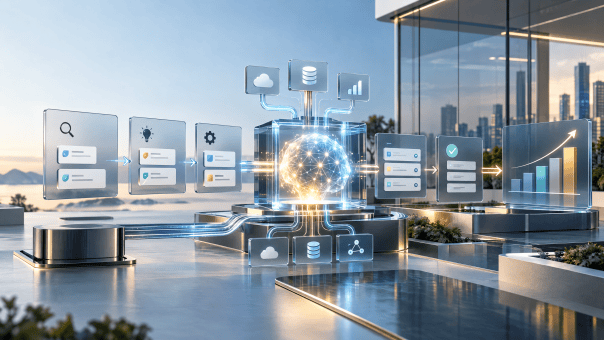
Foundation Models Are Commodities; The “Harness” Is the Asset: The model accounts for less than 20% of enterprise AI success. True enterprise differentiation lives in the surrounding architectural harness the security guardrails, evaluation benchmarks, and deep integrations with systems of record.
From Predictive Insights to Autonomous Execution: AI has evolved from back-office prediction (such as generating static churn spreadsheets for human outreach) to orchestrating end-to-end execution across phone, email, and live transactional workflows.
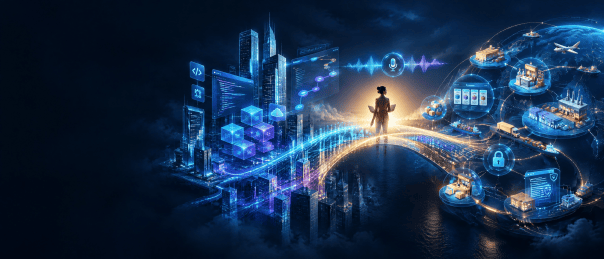
Bridging Internal Systems with External Reality: The highest enterprise ROI emerges at the intersection of internal systems of record (ERPs, core banking, loan origination) and dynamic external data (market pricing, credit bureaus, real-time freight and transportation indices).
Transparent Reasoning Over Black-Box Decisions: In regulated industries, enterprise-grade multi-agent systems must expose their reasoning paths (“the why, the what, and the how”). Auditability and anti-fragile architectures are non-negotiable prerequisites before granting autonomous execution authority.
Actionable Steps to Move Beyond Pilot Purgatory
Shift Focus from Prompting to Native System Protocols: Move beyond brittle, surface-level API connections and basic text wrappers. Implement standard protocol integrations like the Model Context Protocol (MCP) to give autonomous agents native, structured access to core business databases and transaction layers.
Implement Continuous Agent Evaluation Frameworks: Real-world environments are full of edge cases that controlled demos ignore. Deploy rigorous evaluation engines capable of testing agentic workflows against thousands of edge cases before pushing configuration or model updates into live production.
Minimize Human Friction in Workflow Redesign: High-accuracy systems fail when they impose unnatural cognitive burdens on staff. Embed AI seamlessly into existing operational views delivering contextual answers directly within active workflows rather than forcing teams into separate tools.
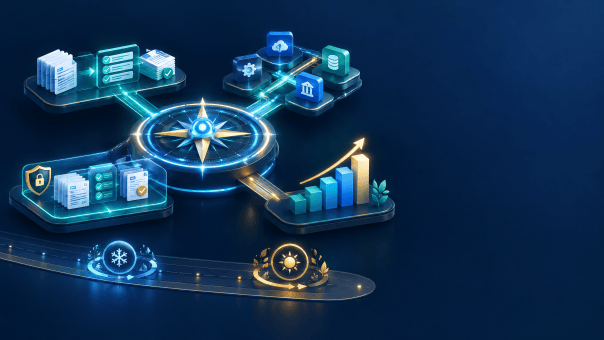
Define Measurable Commercial Milestones Upfront: Do not initiate pilots measured solely by technical accuracy scores. Require concrete business metrics such as turnaround time compression, customer acquisition win rates, or operational cost reduction—before code is written.
Watch the Full Podcast Interview
Discover what separates failed experiments from production-grade enterprise AI:
📺 Watch on YouTube: YouTube Episode
Join the AIScento Community
1️⃣ Listen: Spotify
2️⃣ Discover: AIScento Platform
💼 Connect: AIScento LinkedIn.